
Just got a message from the seller on Amazon that my Sharkoon headset is on the way! Looking forward to 5.1 surround sound!
Author Archives: Donncha
Running and gunning in Favela in MW2
Since David posted a video a while back I might as well post this one here.
This game is from January 18th, shot on a Flip Mino on a tripod as I sat slightly to the side. I was wearing headphones so no sound except my occasional grunts and curses. I edited out the bit at the end where I stood up too quickly and knocked over the tripod. 🙂
Oh, and I can’t believe I missed that guy lying on the ground. I stunned him but thought someone else had finished off the job as he wasn’t moving.
Jonathan Ross using Natal. Can’t see my…
Jonathan Ross using Natal. Can’t see myself jumping around in my small home office like that.
Phishing in Irish
Well, this is a surprise. One of my .ie email addresses got a very targeted phishing email. It was so specific that it was actually written in Irish! It wasn’t directed at me, but at a list owner address at linux.ie.
I wonder if the spammers know how many Irish people could actually read their email easily? It’d certainly be easier for most people to read in English.
Aire
Tá mé an tUasal Patrick KW Chan an Stiúrthóir Feidhmiúcháin agus Príomh-Oifigeach airgeadais Hang Seng Bank Ltd, Hong Cong.
Tá mé togra gnó brabúsaí leasa choitinn a roinnt le leat;
Baineann sé leis an aistriú suim mhór airgid.
Fuair mé do tagairt i mo cuardach a dhéanamh ar dhuine a oireann mo chaidreamh gnó molta.
Má tá suim agat i obair liom teagmháil a dhéanamh liom mo trí r-phost príobháideach (mrpatkwchan52@yahoo.com.hk) le haghaidh tuilleadh sonraíDearbhófar do fhreagra túisce chun an litir seo a mhór.
An tUasal Patrick Chan
E-mail: mrpatkwchan52@yahoo.com.hk
I suppose it was bound to happen now that Google translates text into Irish. Well done to Gmail for marking it as spam!
Wow, 17-4 on Derail. What a fluke :)
Wow, 17-4 on Derail. What a fluke 🙂
Ok, so Commando gives you a longer lunge…
Ok, so Commando gives you a longer lunge when knifing. I wasn’t sure just how far it was until I read this post and saw this video and the other one David linked to. Amazing.
Should it be removed? Hell no. Equip yourself with a shotgun and if you’re in close quarters use that instead of your primary weapon. Either that or don’t stay in the one corner.
Oh, if you’re interested in knifing, check out ONLYUSEmeBLADE.
Great MW2 poetry!…
Great MW2 poetry!
A version of Go may be coming to XBLA! I…
A version of Go may be coming to XBLA! I remember playing a version of Go on my Palm IIIx, but haven’t found a decent game of it on any of my Nokia phones.
I play games and I blog. Currently addic…
I play games and I blog. Currently addicted to Modern Warfare 2 on Xbox Live.
Gooochi talks to /bc/123kah.php
This is weird, a huge number of POST requests started to hit the Shite Drivers website a few days ago. The requests came from lots of IP addresses and all requests went to the non existent /bc/123kah.php
The payload was an array that looked like this:
Array
(
    [showed] =>
    [clicked] =>
    [version] => 2.6.2.4
    [id] => c3b342beb6ad7adf39499e7a38f93c09f681611d
    [tm] => 1266855758
    [aff_id] => gooochi
    [net_id] => gooochi
    [safe] => 1
    [exceed] => 2505,2507,2582,2597,2602
)
So I presume it’s the Gooochi malware referenced in this search for that word. Strange that the infected PCs hit my server though.
The traffic was never overwhelming but I decided to put a stop to it with a simple
in a .htaccess file. Much better than having WordPress serve up a 404 page.deny from all
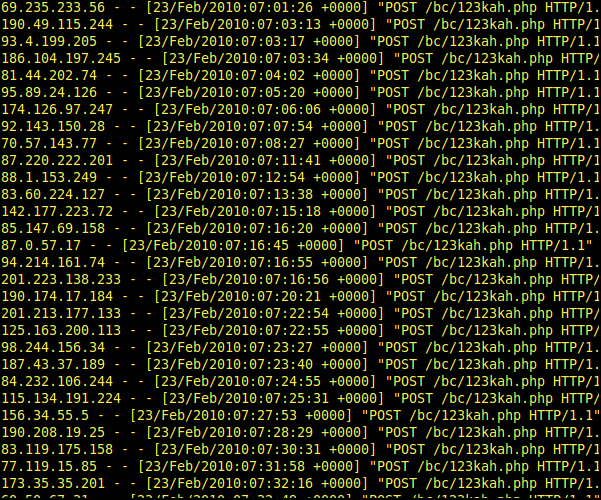
I mentioned the 123kah.php file on Twitter and I’m not the only one to see these odd requests. I guess even malware has bugs! (which is all the more reason to keep your anti-virus software up to date if you use Windows)